
The Missing Layer in ABM: How Intent Signals Turn Targeting into Timely Growth
Account-Based Marketing is becoming a strategic priority for organization as it assures precision in targeting, and a more targeted path to growth. Teams invest in defining the right accounts, aligning marketing and sales, and developing a structured engagement plan which is designed for delivering consistent outcomes.
- March 26, 2026
- Posted by: target
- Category: Blogs
On an initial level, this strategy works. Teams know who they want to reach out and the way to approach them. The base is strong, and strategy appears well aligned with business goals.
Studies indicate that nearly 70% of B2B buyers define their needs before engaging with vendors, which means a large portion of target accounts may not be actively in-market when outreach begins.
Some accounts engage instantly and move forward, while others, in spite of being equally qualified, remain inactive for a prolonged period. This variation in results becomes more visible as campaigns grow.
This inconsistency raises an important question. If the targeting is accurate, what is driving the difference in results?
The answer lies in a layer that traditional ABM approaches do not fully capture the understanding of when an account is ready to engage.
The Three Layers That Define Account Readiness
This includes firmographic, technographic, and organizational characteristics which define whether an account aligns with solution. This layer ensures that efforts are focused on accounts that have the right structure, scale, and environment.
These signals capture real-time behavior, including external research activity and internal engagement. They indicate how actively an account is exploring a problem and how its interest is progressing across different stages.
These include strategic events, hiring patterns, and business changes that add depth to intent. They help explain urgency, priority, and the broader environment influencing decision-making.
Together, these layers provide a more complete view of both alignment and timing, enabling teams to move beyond static targeting and engage accounts with greater precision.
Fit vs. Outcomes: Bridging the Gap
Traditional ABM models are built on strong foundations. Firmographic, technographic, and organizational signals assist in identifying companies who are structurally aligned with a solution. These signals make sure that teams target accounts with the right scale, technology environment, and intent capabilities.
This layer of understanding is crucial. It answers an important question: Is this account relevant for us?
However, relevance does not always convert into readiness.
A company which perfectly matches an ideal customer profile might not be actively exploring solutions today. At the same time, another organization, which is less visible in static data, might be actively researching, evaluating options, and building internal momentum.
When both are treated with the same priority, effort becomes evenly distributed, but outcomes do not.
Takeaway:
The difference lies in movement but not in fit.
Understanding Intent as a Continuous Signal
Intent signals introduce different lenses. Rather than focusing on static characteristics, they capture behavior: what companies are actively doing throughout their buying journey.
But intent is often misunderstood as isolated activity.
A single website visit or content interaction might be sometimes interpreted as a meaningful engagement. But in reality, individual signals rarely provide enough clarity.
What creates value is the progression of signals.
Early-stage signals typically reflect exploration: Companies engage with broad topics, creating awareness of a challenging landscape.
As interest deepens, signals become more focused on interactions to shift toward specific themes, categories, or solution areas.
In later stages, engagement becomes more deliberate, often indicating evaluation and comparison.
Seen individually, these signals are fragments, but when seen together, they form a pattern.
Takeaway:
Intent, therefore, is not a moment. It is a trajectory.
The Role of External Intent in Identifying Early Movement
One of the most valuable aspects of intent signals is the visibility they provide before a company interacts with your brand.
External intent signals capture how organizations engage with content across industry platforms, research ecosystems, and publisher networks. Rather than focusing on a single source, these signals are built by observing topic-level behavior across multiple environments.
When companies consistently engage with specific topics across different platforms; and when that engagement increases over time, it indicates that a journey has begun.
How teams capture and validate external intent signals in practice:
To make external intent actionable, teams combine multiple data sources, each contributing a different layer of visibility:
→ Track topic-level research behavior across publisher networks and data ecosystems
These platforms help answer:
“Which companies are actively researching problems we solve, even before they visit us?”
→ Identify accounts evaluating categories, competitors, and alternatives
These signals indicate:
“This account is not just exploring it is evaluating options.”
→ Capture early-stage educational engagement across external content ecosystems.
These signals reveal:
“Which accounts are entering the awareness and exploration phase.”
→ Validate whether external research is translating into direct brand interaction
This layer confirms:
“Is external interest turning into real engagement with us?”
Takeaway:
This early visibility enables teams to identify accounts at the very start of their exploration phase, well before traditional inbound signals appear.
From Activity to Insight: Why Signal Aggregation Matters
A core fundamental of the intent scoring taxonomy is that no single signal should drive decision-making.
Meaning emerges only when signals are aggregated, weighted, and interpreted in context.
For example, one instance of engagement may indicate curiosity. Repeated engagement across different channels adds consistency. When this behavior aligns with deeper interactions and sustained frequency, it starts indicating intent with greater confidence.
Not all signals carry equal importance. Some represent early exploration, while others suggest stronger evaluation. A structured scoring approach assigns appropriate weight to each signal and tracks how they accumulate over time.
Different actions indicate different levels of intent.
- Low-intent → Blog visits, ad clicks
- Mid-intent → Content downloads, webinar participation
- High-intent → Pricing page visits, demo requests
This transforms raw activity into actionable insight.
Takeaway:
Instead of reacting to isolated interactions, teams gain a clearer understanding of where an account stands and how it is progressing.
Adding Context: The Layer That Brings Clarity
While behavioral signals provide a strong direction, context brings together everything.
A few tools' picks are Crunchbase, Google Alerts, Owler. They capture strategic events that shift priorities and indicates if something changed that creates urgency or budget availability?
Tools that we can use for this is LinkedIn Jobs, LinkedIn Sales Navigator
These contextual inputs add depth to intent data, ensuring that signals are interpreted within the broader business environment of each account.
Takeaway:
When fit, behavior, and context are combined, prioritization becomes significantly more precise.
Moving from Campaign Execution to System-Driven ABM
As these layers integrate, ABM begins to evolve.
Instead of operating a series of campaigns applied uniformly throughout accounts, it becomes a system that adapts continuously based on signals.
Accounts are no longer being treated equally, and engagement is shaped by readiness.
- Early-stage accounts are approached with content that supports exploration.
- Mid-stage accounts receive more focused narratives aligned with their interests.
- Late-stage accounts are engaged with greater precision, often in closer alignment with sales.
This shift minimizes the guesswork and creates a coordinated approach between teams.
Takeaway:
Marketing and sales are working from shared visibility into account behavior and progression.
How TargetOrate Brings This Together Through TargetPath
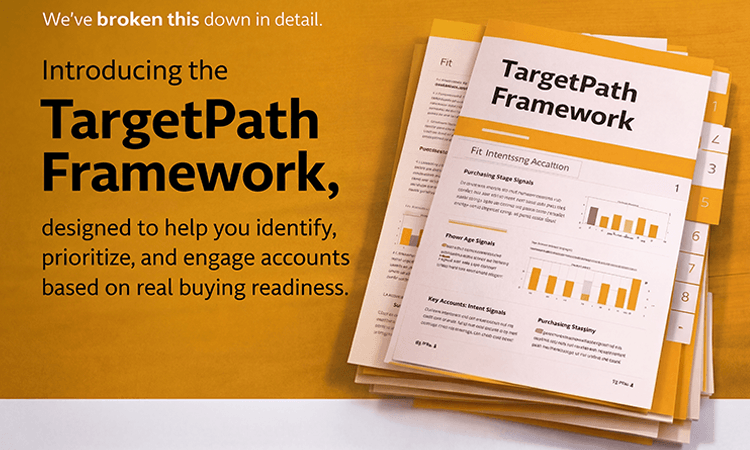
TargetOrate’s TargetPath approach is designed to bring clarity and consistency for the whole process. It combines multiple layers of signals: fit, intent, and context into a unified system which continuously evaluates account readiness.
Signals are not just collected, but they are organized, categorized, and scored based on their relevance and progression.
- External intent is captured at a top level through multiple sources.
- Internal engagement is tracked for understanding direct interactions.
- Contextual signals are layered in to provide additional perspective.
These inputs are then aggregated into a coherent scoring model which reflects both alignment and timing.
This not just enables better data but also better decisions.
Teams gain the ability to:
- Identify which accounts are actively progressing
- Understand the stage of each account’s journey
- Align messaging and outreach with real-time behavior
- Prioritize effort where it creates the most impact
TargetPath transforms ABM from a planning exercise into a dynamic system, one which responds to signals rather than assumptions.
Rethinking What Makes ABM Effective
ABM has always been about focus.
Intent signals extend that focus into timing.
They ensure that right accounts are not only identified, but engaged at the right moment, with the right context, and with a clear understanding of their journey.
When this level of clarity is built into the system, ABM becomes more than a strategy. It becomes a coordinated approach to growth, one which is informed, adaptive, and aligned with how buying decisions actually take shape.
Conclusion
Growth is not solely driven by expanding reach or increasing activity. It is shaped by improving the precision of decisions, knowing where to focus, when to engage, and how to align teams effectively.
Intent signals provide that clarity.
They reveal which accounts are entering the market, how interest is changing, and where opportunities are gaining momentum. When integrated with structured scoring and contextual understanding, they create a more reliable foundation for prioritization.
The result is not just better campaign performance, but a more aligned and responsive go-to-market strategy.